


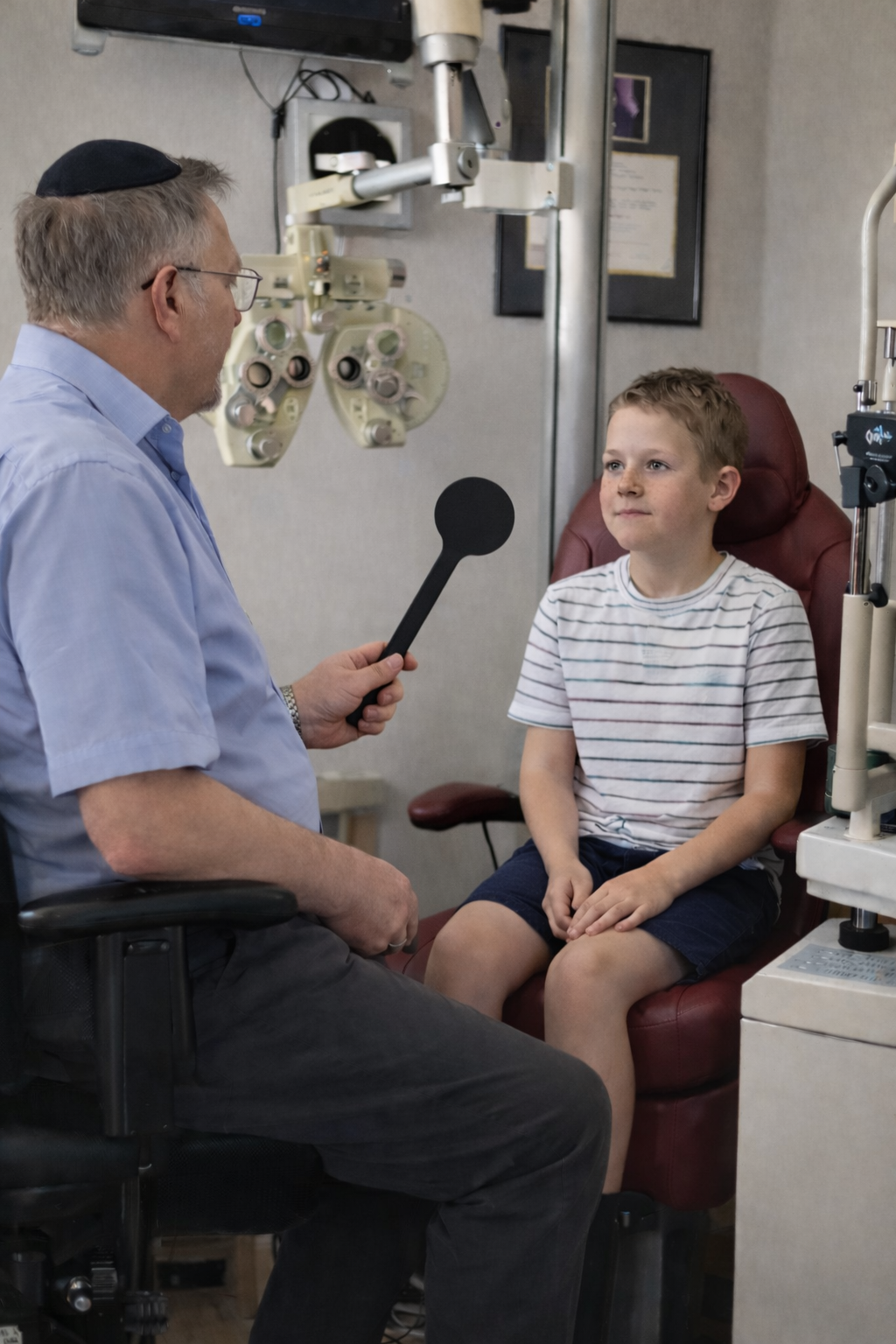
What If the Problem Isn’t Your Child’s Cooperation, But the Test?
Many parents leave an eye examination feeling unsure.
“My child didn’t cooperate.”
“They wouldn’t sit still.”
“They seemed to lose interest.”
Sometimes this is said with concern.
Sometimes with frustration.
Often with a quiet worry that something went wrong.
But in many cases, nothing went wrong at all.
When a child struggles to stay focused during a vision assessment, it is not always a behavioural issue.
Very often, it means that the test is not well matched to how they see and attend.
Vision tests don’t always suit every child
Most standard eye tests are designed for patients who can easily adapt to the test.
They are expected to:
-
Sit still
-
Look on demand
-
Respond quickly
-
Ignore discomfort or tiredness
For many children, this is not natural.
When a test places too much demand on attention or visual control, focus drops.
Not because the child is “difficult”, but because the test does not yet fit them.
That moment, when attention slips and then returns, already gives us valuable information.
We adapt the test to the patient
At our clinic, we do not expect children to fit a rigid testing system.
We adapt the examination to the child.
This means adjusting how we test according to:
-
Age and stage of development
-
Attention and learning style
-
Cognitive abilities
-
How the child naturally engages with the world
For younger children, this may involve playful and changing targets.
For school-aged children, we observe how vision holds during real tasks.
For adults, we focus on how vision supports daily activities such as reading, work, and movement.
This approach is not about making tests easier.
It is about making them more meaningful.
Understanding how vision works in everyday life
When testing is adapted in this way, the results become clearer and more useful.
We are able to see:
-
How vision supports learning and concentration
-
How well the eyes work together over time
-
Whether visual effort may be contributing to tiredness, headaches, or avoidance
Most importantly, we begin to understand how a person uses vision in real life, not just how well they read letters on a chart.
Parents often notice the difference immediately.
Children feel more relaxed.
The assessment feels calmer and more natural.
Adults feel listened to and understood.
A neuro-developmental approach to vision
Our work is based on a neuro-developmental understanding of vision.
This means recognising that vision is not just about the eyes.
It is about how the brain processes visual information to guide learning, movement, and interaction with the world.
Assessing vision in this way requires specialised training, experience, and careful clinical judgement.
It is a skill developed over many years of clinical and teaching work.
Why families travel to see us
Over time, families have travelled to see us from across the country and from around the world.
Many arrive after being told that everything is “normal”, even though daily difficulties remain.
They are not simply looking for reassurance.
They are looking for clear answers and practical guidance.
The benefit for you and your child
When vision is assessed in this way:
-
Findings make sense in everyday life
-
Recommendations are personalised and relevant
-
Parents gain confidence in the next steps
Most of all, patients feel seen and supported.
Because good vision care is not only about seeing clearly.
It is about helping each person meet the world with confidence and comfort.


